
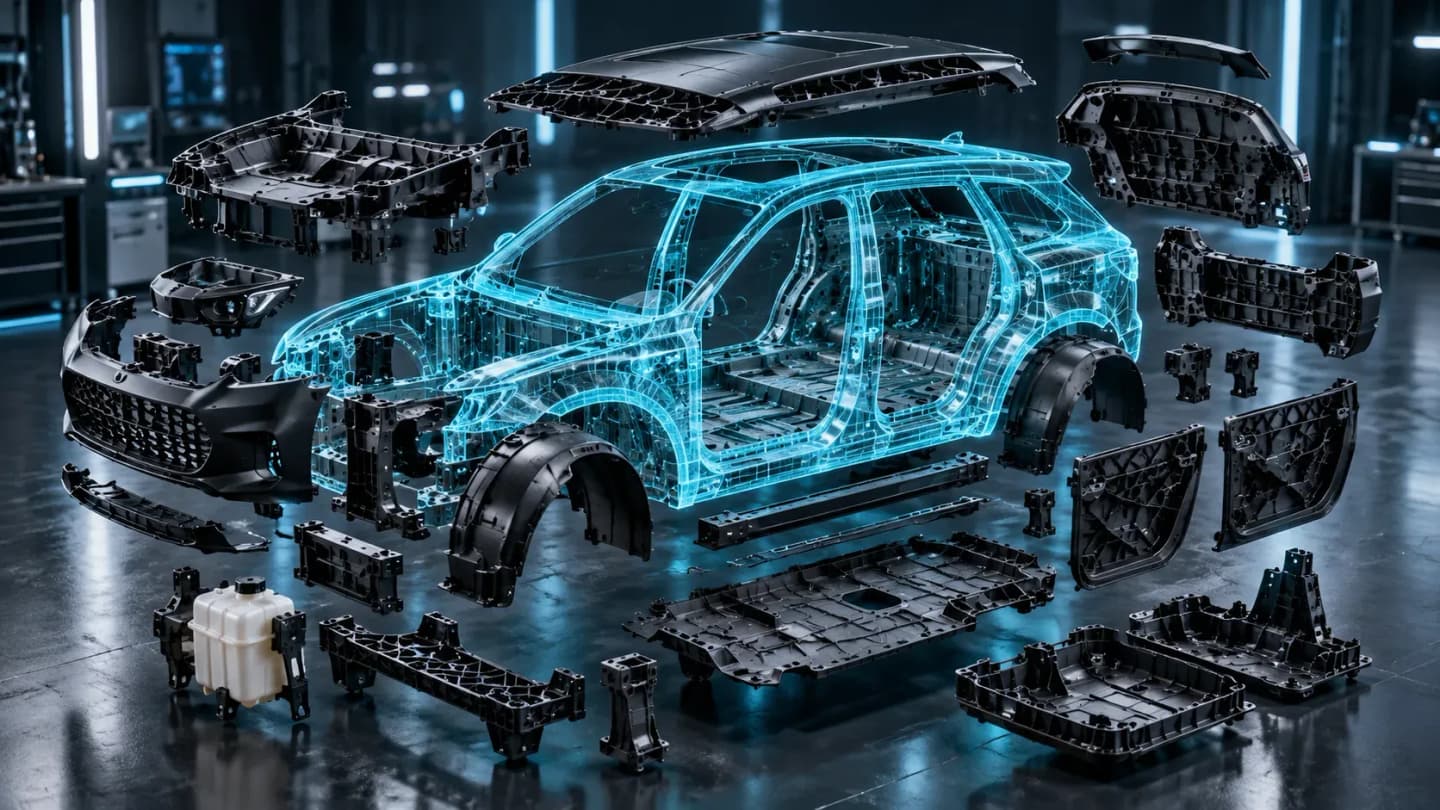
Lightweighting is a system decision
Replacing a metal part with polymer is not a one-for-one material substitution. Load paths, fastening, creep, temperature, impact, chemical exposure and assembly behaviour must be reconsidered as a connected system.
The strongest programmes align product engineering, material selection, simulation, tooling and process limits before the design becomes expensive to change.
Geometry carries more responsibility
Ribs, bosses, transitions and local thickness changes can deliver stiffness efficiently, but they also influence filling, packing, cooling and appearance. Draft and ejection strategy must be resolved without weakening functional interfaces.
When fibre-filled polymers are used, flow direction can change stiffness and warpage. Gate position and moulding sequence therefore become part of the structural design conversation.
Production evidence closes the loop
A lightweight component should be validated against measurable functional and dimensional requirements, not only target mass. Trial data, inspection results and controlled process windows help distinguish a robust design from a successful first sample.